It’s November and as many businesses start closing out the year, they also start looking further ahead. Of course, no outlook for 2027 would be complete without a scan of what’s coming in the AI landscape. Given the Jensen Huang resignation and fears of a stock market bubble collapse, many are wondering if it’s all a house of cards that’s about to come down. When earlier this week I delivered an executive briefing for The Rialto Consultancy on the AI trends senior leaders need to know for 2027, I covered not just the tech shifts, but also what’s coming at the organisational and economic levels too.
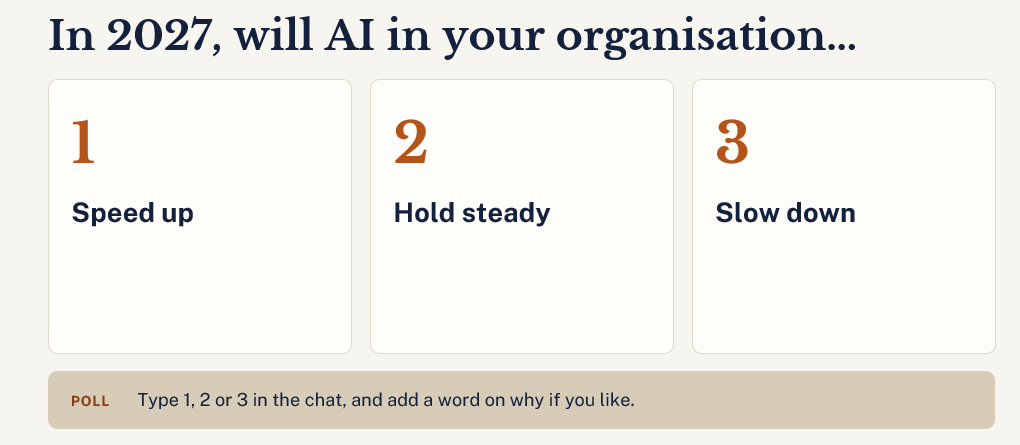
Before sharing my own expectations, I ran a quick poll:
Do you expect AI adoption in your organisation to speed up, hold steady or slow down next year?
There was clear consensus: ‘speed up’!
This is in line with what I’m seeing in the data (more on that below). But it also highlights what I think will be the defining issue of 2027: AI capabilities and investment are advancing faster than the capacity of organisations to use them effectively.
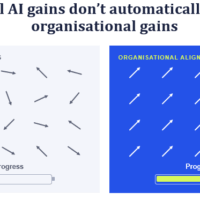
I looked at three interconnected levels, with three shifts I’m watching at each:
Adoption among enterprises continues to spread. I find Ramp’s AI Index particularly interesting because it measures what businesses actually spend on AI rather than what they say they use. In October 2026, nearly 57% of the more than 85,000 US businesses in its dataset were paying for AI tools, up from around 44% a year earlier.
And the technology itself continues to improve while becoming dramatically cheaper. Epoch AI estimates that since 2023 the cost of achieving a given level of AI performance on selected benchmarks has fallen by an average of 47% per quarter. The decline in cost is happening 4 times faster than DNA sequencing and 54 times faster than electricity.
Access to cheap and powerful AI is just one part of the story. Over the past year, I’ve noticed a change in the conversations I’m having with business leaders. Twelve months ago, the questions were largely exploratory: ‘What can AI do? Which tools should we try? What pilots should we run?’
Now the questions are becoming more uncomfortable: ‘We’ve invested in AI. Where are the results? How do we show what impact it is having?’
With the 2026 context in mind, let’s look ahead.
Level 1. Technology: from AI assistants to agents and intelligent machines
1. AI agents are the future…and always will be…until trust closes the gap
Much of the excitement around AI has focused on generative AI and what it can produce: text, images, software, analysis and ideas. But the next phase is about what AI can do. This is where agentic AI comes in. Its power comes from that ability to act on your behalf: you give it a goal, and it can plan, make decisions and take actions towards achieving it, within the permissions and constraints it has been given. Imagine an AI system responding to a missed delivery. Rather than simply alerting a supply chain manager, it could identify alternative suppliers, assess the implications, adjust orders and update internal systems.
Now remember, at the start of 2026, many consultancies also hailed it as the year of agentic AI. So what’s happened? Turns out trust matters! There’s a fascinating contrast between what we’re being told agentic AI can do and how ready people are to use those AI agents.
In early November, Uber disclosed that during its busiest week in October, it handled approximately 320 million rides and food orders. Of those, how many Uber rides were arranged through third-party AI agents?
Four. There were also approximately 500 Uber Eats orders placed by agents. Uber’s CEO, Dara Khosrowshahi, said: ‘it’s still very, very early and very limited traction’.
I am not saying that AI agents won’t transform consumer services. But the Uber example suggests that the value proposition isn’t obvious for every task. When booking a ride already takes seconds, the benefit of delegating it to an agent may be limited, and would be more apparent in other situations such as a multi-modal trip.
Inside businesses, however, adoption is moving faster. McKinsey’s 2026 State of AI research found that 40% of organisations with annual revenue exceeding $1 billion were scaling AI agents in at least one function, up from 27% a year earlier. Among smaller organisations, the figure remained around 22%.
But governance is lagging. BCG’s 2026 research found that 42% of companies expect to give AI agents genuine decision-making autonomy by 2030. Yet only 5% currently have the necessary controls in place.
That gap between investment and governance in agentic AI is one to watch closely. Why? Because it fundamentally breaks the link between action and accountability. In human-only workforces, the human takes the action and is accountable. Now the machine takes the action, but the human is still responsible, though not always fully aware of the actions the agent is undertaking on their behalf. Even the most sophisticated AI labs don’t fully understand how this works (remember the Hugging Face incident?!) so how could the rest of us possibly know?
2. Beyond the screen: physical AI is next, but it will take longer
This might sound futuristic but I think it’s one we can expect to hear more about beyond 2027. The next frontier takes AI beyond software and into the physical world: robots, vehicles, machinery and other intelligent systems.
According to the International Federation of Robotics, more than 600,000 industrial robots were installed in factories worldwide in 2025, bringing the total operating population above five million.
Two aspects I find interesting in the data.
The first is the geopolitical dimension. China accounted for 59% of new installations. The US overtook Japan as the second-largest market, while installations declined in Germany and Japan. These shifts have important implications for industrial competitiveness, particularly in Europe, where many commentators bemoan the failure of European policymakers to act fast enough when it comes to emerging tech.
The second is the shift from single-use robots to world models. Most industrial robots today are conventional machines designed to perform specific programmed tasks. What’s changing is the development of AI systems capable of understanding and responding to their surroundings. Researchers are developing what are known as world models, which allow machines to simulate physical environments and anticipate the consequences of their actions. Gartner included world models among its top strategic technology trends for 2027.
My expectation is that 2027 will bring more pilots, investment and experimentation in physical AI, but the widespread transformation of industries will take longer. If you’re interested in this space, here is my article in MIT Sloan Management Review: Robots Are Coming—but Not Everywhere.
3. A less glamorous constraint: data is holding AI back
Another trend worth paying close attention to in 2027 is technology that enables more robust data infrastructures. It is becoming clearer to technology companies that adoption of AI is being held back by an old organisational problem: poor-quality data.
In my interviews with AI strategists, data preparation repeatedly emerges as one of the biggest demands on time and investment. One of them said that up to 85% of AI project budgets go to data cleaning because there is no single source of truth.
Some executives recognise that getting the data right is paramount. One healthcare technology executive told me: ‘Agentic AI is a forcing mechanism to make sure we’re on the journey toward consistently good data.’ If your agents are being given the wrong information, the potential risks multiply enormously.
Level 2. Organisations: from AI investment to AI accountability
I expect 2027 to be the year in which the conversation shifts decisively from how much organisations are investing in AI to accountability. Accountability for ROI, and for the impact those investments have on the firm and the wider economy.
4. Using AI is not the same as showing evidence of value
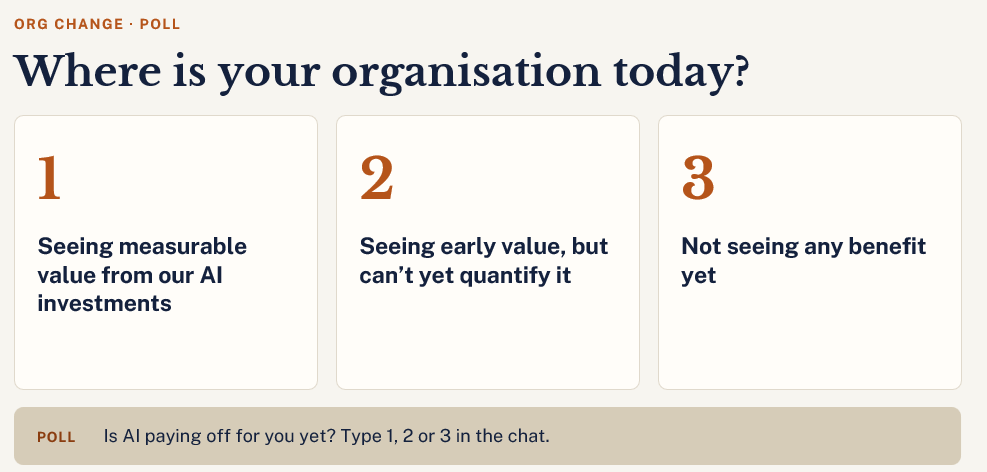
During my Rialto briefing, I asked participants whether their organisations:
The dominant answer? 2. They are seeing early value but cannot quantify yet.
It’s a question I find particularly revealing because it forces us to distinguish between using AI and benefiting from AI.
Many organisations measure AI adoption through licences, logins, prompts and the number of employees who have completed training. These are all input type of metrics. Boards and investors increasingly want to understand what has actually changed – they want to see outcomes: productivity, revenue, costs, quality, customer experience or competitive advantage.
An international study involving nearly 6,000 business leaders, published earlier in 2026, found that 69% of businesses surveyed were using AI in some form. Yet 89% reported no effect on labour productivity over the preceding three years.
Of course, productivity is difficult to measure, and some companies are already achieving meaningful returns. As an economist, I’m reminded of Robert Solow’s famous observation in 1987 that the computer age could be seen everywhere except in the productivity statistics. Some economists are seeing signals of productivity improvements. Official US figures, highlighted by Erik Brynjolfsson, show productivity grew at a 3.6% annual rate in the latest quarter. That’s more than double the 1.5% average from 2007-2019.
5. The AI readiness gap: who owns making the whole organisation ready?
I call it the AI readiness gap: the growing disconnect between what organisations invest in AI and how prepared their people are to use it effectively.
Under pressure to deliver results, leaders naturally gravitate towards the things they can see and control: technology platforms, systems, budgets and implementation plans. But technology alone cannot transform how an organisation works.
BCG’s 10–20–70 framework suggests that successful AI transformation requires only around 10% of the effort to focus on algorithms, 20% on technology and data, and 70% on people, processes and organisational change.
One problem I repeatedly encounter is what I think of as a leadership vacuum.
The CTO focuses on the technology stack. The people function concentrates on skills and culture. Learning and development teams design training programmes.
Each has a legitimate role, but who is responsible for making the whole organisation ready?
Even when companies appoint AI adoption leads, these roles can be positioned too far down the hierarchy, or within a single function, to influence the necessary changes across the business.
I expect this fragmented approach to come under increasing pressure in 2027.
6. Accountability reaches the top
Much of our conversation around AI has been about AI eliminating entry-level roles or automating professional knowledge workers. One thing to watch is how many CEOs make the news as the pressure for accountability around AI reaches the top. In a 2026 survey of 900 CEOs by Dataiku, 80% believed their job could be at risk if they failed to deliver results from AI by the end of 2026.
One of my research interviewees put it particularly well: ‘You can delegate authority but not accountability.’ An AI agent might make a decision, execute a transaction or interact with a customer. But when something goes wrong, a human leader is still expected to explain why it happened and take responsibility.
No wonder that confidence in leading this change is fragile. In my own survey of nearly 200 senior leaders for AI-Q, just 31% said they felt very confident leading their teams through AI-driven change. For leaders who got where they are by confidently being the most knowledgeable person in the room that is a hard thing to admit to.
And if organisations cannot demonstrate the value of their AI investments, some may choose to slow down rather than continue investing on the strength of expectations alone. This is part of the reason that I expect to see some consolidation of AI investments in the year ahead, despite the dominant consensus of “speeding up” AI adoption in the leadership audience poll.
Level 3. Economy and society: from AI enthusiasm to friction and backlash
The third level extends beyond the organisation. AI is increasingly becoming an economic, political and social question, not simply a technological or business one. The Jensen Huang story that’s unfolding (he has announced his resignation as CEO as I write this) illustrates this perfectly. And I expect 2027 to expose more of the tensions between the desire to accelerate AI and the consequences of doing so.
7. Governments are pressing the accelerator and the brake
Governments are caught in what I see as a tug of war – trying to accelerate and rein in AI at the same time. They want to attract AI investment, build national capabilities and improve economic competitiveness. They recognise that the push for sovereign AI requires governments backing AI companies. At the same time, they face demands to protect citizens, workers, businesses and national security and to stop the unfettered rise of harms from AI.
In April 2026, the UK launched its £500 million Sovereign AI Fund to support domestic AI companies. Meanwhile, the European Union amended the timetable for parts of its AI Act, moving the application of certain high-risk AI obligations to December 2027. Across the United States, individual states are introducing different approaches to AI regulation.
8. Backlash is becoming an economic cost
The public backlash is visible both outside and inside organisations. Data centres have become the poster child for mistrust of AI. Data Center Watch reported that during the first quarter of 2026, local opposition blocked or delayed at least 75 US data centre projects worth approximately $130 billion. That’s roughly the same scale of disruption as the whole of 2025, concentrated into just three months.
Or consider the reaction inside organisations. In October, privacy technology company Proton faced criticism after employees were told they would undergo interviews assessing how they used AI, with potential consequences for their employment. Following employee and customer backlash, the company cancelled the process.
Both examples illustrate that AI adoption does not happen in a vacuum. Communities, employees, customers and other stakeholders influence the pace and conditions under which it happens. Ignoring their concerns can create costs of its own for business leaders.
9. What happens to the next generation of workers?
There is another development that I think we will hear more about in 2027: the narrowing of opportunities for young people entering the workforce.
Research by Erik Brynjolfsson and colleagues at Stanford uses payroll data covering millions of US workers. Their August 2026 update found that employment among 22–25-year-olds in highly AI-exposed occupations was 19% below where it would have been had it kept pace with similarly aged workers in less-exposed occupations.
The researchers do not claim that AI alone explains this gap, nor do they find evidence of widespread job displacement across the economy. But the pattern is concerning, particularly because it appears to reflect reduced hiring of younger workers.
I’ve spoken with hundreds of young graduates at careers festivals and recruitment events. Many have told me they feel unprepared for what they describe as an impending ‘AI tsunami’. This is a question we all need to confront, and one I believe business leaders have a particular responsibility for – and will be called on to respond to: if we automate away the entry-level work through which people traditionally learn, where will our future experts and leaders come from?
Beyond Pandora’s box and panacea
All three levels point towards a larger question: how should leaders respond to the uncertainty surrounding AI?
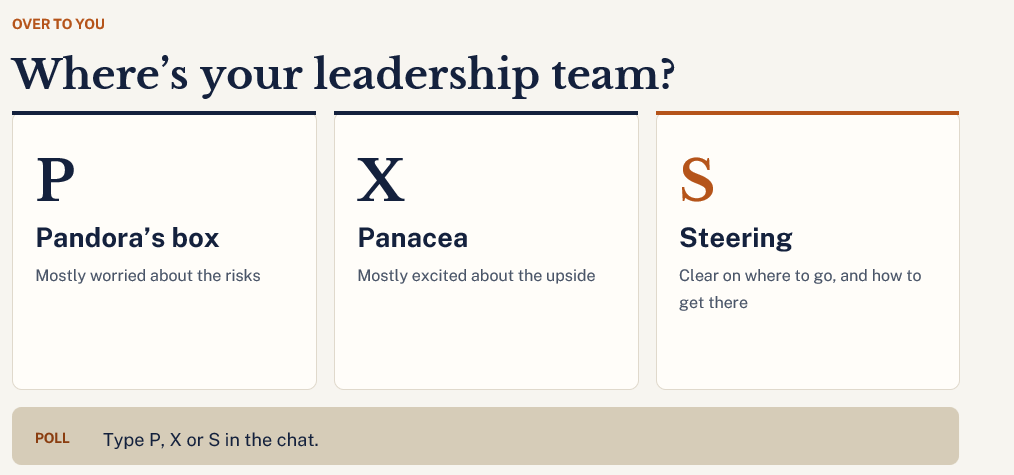
Much of the public debate tends towards two extremes. On one side, AI is Pandora’s box: a technology that threatens jobs, safety, privacy and even humanity itself. From this perspective, our priority should be to contain it. On the other, AI is a panacea: a technology that promises extraordinary advances in medicine, science, education and productivity. From this perspective, our priority should be to accelerate.
At my Rialto briefing, I asked leaders to consider which of these positions best described their leadership teams.
Were they mostly worried about the risks? Mostly excited about the opportunities? Or were they genuinely steering, with a clear sense of where they wanted to go?
The consensus? ‘Mostly excited about the upside’. A handful said ‘mostly worried about the risks’. And far fewer described their organisations as actively steering.
I suspect that reflects the position of many leadership teams today, not just those in this particular meeting.
In 2027 the shift towards accountability means that there will be a need for leadership teams to choose a third path: to steer. To go beyond seeing just the opportunity or just the risks and rethinking your role in all this as a leader.
Five questions for leadership teams in 2027
As we approach 2027, I’d encourage every leadership team to consider five questions:
Are we building our organisation for the human + AI era, or just buying the technology? Who owns making our people, processes and culture ready, and how will we know it’s working beyond logins and licences?
Do the people we serve trust how we use AI? Inside and outside the organisation, what would it take to earn and keep that trust?
Who is accountable when AI makes decisions? Are our governance, oversight and responsibilities keeping pace with growing autonomy?
What kind of future are we helping to build? What are we doing to keep entry-level roles as places where people learn, so we still have experts and leaders in ten years?
Are we steering or drifting? Can we say clearly where we want AI to take the organisation, and what we will not do?
This essay draws on an executive briefing delivered for The Rialto Consultancy in November 2026 and original research for my forthcoming book, AI-Q: The New Leadership Imperative for the Human + AI Era, published on 12 January 2027.
Research note: The AI-Q finding cited above comes from an online survey of nearly 200 senior leaders responsible for organisational functions. It reflects self-reported confidence and should not be interpreted as representative of all senior leaders.
About Athena Peppes
Athena Peppes is an economist and futurist who advises senior leaders and speaks internationally on AI leadership and the future of work.
To provide the best experiences, we use technologies like cookies to store and/or access device information. Consenting to these technologies will allow us to process data such as browsing behaviour or unique IDs on this site. Not consenting or withdrawing consent, may adversely affect certain features and functions.
Functional
Always active
The technical storage or access is strictly necessary for the legitimate purpose of enabling the use of a specific service explicitly requested by the subscriber or user, or for the sole purpose of carrying out the transmission of a communication over an electronic communications network.
Preferences
The technical storage or access is necessary for the legitimate purpose of storing preferences that are not requested by the subscriber or user.
Statistics
The technical storage or access that is used exclusively for statistical purposes.The technical storage or access that is used exclusively for anonymous statistical purposes. Without a subpoena, voluntary compliance on the part of your Internet Service Provider, or additional records from a third party, information stored or retrieved for this purpose alone cannot usually be used to identify you.
Marketing
The technical storage or access is required to create user profiles to send advertising, or to track the user on a website or across several websites for similar marketing purposes.